

Eliza Harriott, wife of Francis, the son of Jenny Harriott, was born a survivor. In the year of her birth as ‘Eliza Young’ on the Appleton Estate in St Elizabeth in 1832, 17 people she was enslaved with died.
The circumstances surrounding their deaths help illuminate the brutality of chattel enslavement, its impact on the mortality of the enslaved and coexistence of life and death on the plantations.
A Brief History of Appleton Estate
The Dickinson family from Wiltshire in England, were one of the biggest slave-owning families in the region. Francis Dickinson was the first to arrive during the 1655 invasion to defeat the Spaniards, receiving 2000 acres of land from King Charles II for his role in the Spanish defeat.
Records in the Wiltshire and Swindon History Centre that include account books held by Ezekiel Dickinson (1711-1788) show that the Dickinsons owned estates in Jamaica at Barton Isles, Appleton, Pepper, Watchwell and Delacross Pen. Appleton was named after Dickinson’s English hometown. The Dickinsons profited greatly from slavery owning grand estates in England including Bowden House near Lacock, Monks Park near Corsham and several large estates in Somerset.
Death and Disease on Jamaican Plantations
Infant mortality was high on Jamaican plantations with underlying causes including diarrhoea, dysentery, measles, smallpox, whooping cough, and infantile tetanus (referred to as lockjaw). The high mortality rates were especially prevalent among newly arrived enslaved people, who often suffered from lack of food, dehydration, lack of fresh air and depression following gruelling journeys across the Atlantic. There were also frequent outbreaks of yellow fever, smallpox, measles and yaws, which were highly infectious and easily spread on the plantations due to overcrowding and lack of water for washing. Yellow fever was brought to Jamaica from Africa in the mid-1700s and spread through mosquitoes breeding in stagnant water. Enslaved people were also afflicted by ticks attacking uncovered flesh, often becoming infected, and chigoe fleas which lay their eggs by boring into shoeless feet.
Pulmonary infections were brought to Jamaica from Europe. The enslaved had low resistance due to the lack of immunisation, overcrowding, poor diet and being overworked. Dropsy and ulcers were endemic among the enslaved and included coco bays (a type of leprosy) and yaws – a type of syphilis often contracted during childhood. On some plantations at any given time almost 17 per cent of enslaved people suffered from yaws.
The biggest cause of death on Jamaican plantations was old age or debility. Life expectancy at birth was less than 30 years for Creoles (those born in Jamaica) and 12 years for those born in Africa. The term ‘debility’ appeared as a frequent cause of death in plantation records from the late 18th to early 19th centuries, especially leading up to emancipation. Debility is not a specific medical condition but was a vague term used by overseers, doctors and those maintaining plantation records. It was used to describe extreme exhaustion, weakness and chronic illness without a diagnosis. Underlying causes were overwork – the enslaved endured long hours of hard physical labour which led to exhaustion. A poor diet due to lack of food of nutritional value caused a low resistance to disease and declining health. The prevalence of disease also caused prolonged weakness leading to death. Aside from physical illnesses, the psychological impact of enslavement, separation from family, grief from constant deaths among enslaved communities and brutal treatment also contributed greatly to premature deaths. The prevalence of debility and death among the enslaved prompted Eric William’s seminal work ‘Capitalism and Slavery’, in which he argued that slave owners found it more profitable to work enslaved people to death and replenish their numbers via the Transatlantic Slave Trade than provide humane conditions and medical care to increase numbers by natural means through births.
Death and Disease on the Appleton Estate in 1832
The Return of Slaves for John Salmon Junior, Attorney for the Appleton Estate in 1832, shows that since the previous return, there were 16 births and 17 deaths. The spreadsheet below details those that perished, their age, ethnicity and cause of death. Analysis reveals that deaths were prevalent among the young and old in equal measure with infants succumbing to worms, ticks, lockjaw and yaws. Given the low life expectancy among enslaved people, it is remarkable that some of those dying due to old age and debility survived to their 60s and 70s. However, those that died from common diseases including pleurisy, pulmonary disease, fever and consumption had an average age of 30.5 years. Eliza’s birth in 1832 coincided with the Baptist War led by Sam Sharpe, which started in late December 1831 and continued into early 1832.
Monument at Appleton Estate Pays Tribute to Enslaved People
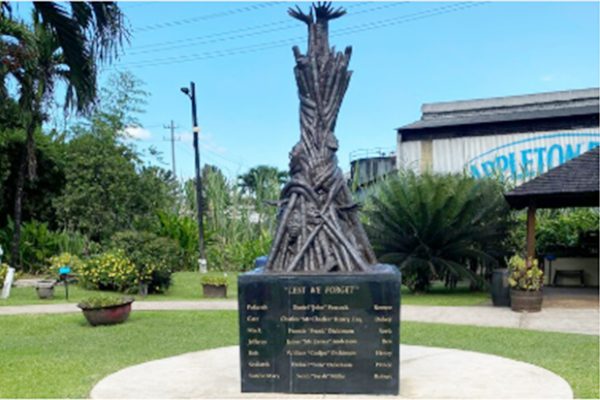
In March 2023, J Wray and Nephew unveiled a monument paying tribute to the enslaved people who worked on the Appleton Estate. The monument was built by Jamaican artist Trishaunna Henry and titled ‘Lest We Forget’. In an article published in The Gleaner bearing witness to the unveiling, Professor Verene Shepherd citing the UN Durban Declaration Article 13 wrote:
“Slavery and the Slave Trade including the Transatlantic Slave Trade were appalling tragedies in the history of humanity, not only because of their abhorrent barbarism but also in terms of their magnitude, organized nature and especially their negation of the essence of their victims. Honouring the victims in any way helps to reclaim their humanity.”
Sources
Burnard, Trevor. Mastery, Tyranny, and Desire: Thomas Thistlewood and His Slaves in the Anglo-Jamaican World. Chapel Hill: University of North Carolina Press, 2004.
Craton, M. (1976). Death, Disease and Medicine on Jamaican Slave Plantations; the Example of Worthy Park, 1767-1838. Histoire sociale/Social History, 9(18).
Death and Disease in Jamaica. Accessed from https://aparcelofribbons.co.uk/2012/01/death-and-disease-in-jamaica/
Higman, B. W. Slave Populations of the British Caribbean, 1807–1834. Baltimore: Johns Hopkins University Press, 1984.
Kiple, Kenneth F., and Kriemhild Coneè Ornelas. The Cambridge World History of Food. Cambridge: Cambridge University Press, 2000.
Shepherd, V. (2023). Why a Monument to the Enslaved at Appleton Estate. The Gleaner. 5 March 2023.
Sheridan, Richard B. Doctors and Slaves: A Medical and Demographic History of Slavery in the British West Indies, 1680–1834. Cambridge: Cambridge University Press, 1985.
Steckel, Richard H. “A Peculiar Population: The Nutrition, Health, and Mortality of American Slaves from Childhood to Maturity.” Journal of Economic History 46, no. 3 (1986): 721–741.
Wiltshires Slave Owners in Jamaica. Accessed from https://wshc.org.uk/wiltshire-slave-owners-in-jamaica/
You May Also Like
Scholarship Award Winners 2026
We are delighted to announce our Annual Scholarship Award winners for 2026 for academic excellence.
Eliza Harriott – Surviving Death and Disease on the Appleton Estate in 1832
Eliza Harriott, wife of Francis, the son of Jenny Harriott, was born a survivor. In the year of her birth…
The History of the Harriotts Told Through Historical Documents
Historical documents I retrieved through painstaking research in the UK and Jamaica have been uploaded to this website to help…
Scholarship Award Winners 2025
JHF Founder and patrons extend warm congratulations to our first annual scholarship awards winners in 2025 .

Hundreds of pounds raised through Easyfundraising
Savvy shoppers have raised hundreds of pounds for Jenny Harriott Foundation through Easyfundraising, which has been donated to Zion Hill Primary School.

Zion Hill Welcome
Students at Zion Hill Primary School give give a warm welcome to Dr Gabriel, Albert and Phillip Harriott, during their…

Zion Hill Staff Reflections
Staff at Zion Hill Primary School share their thoughts and praise for the school and its contribution to the local…

Zion Hill School Principal
Principal of Zion Hill Primary School, Simone-Green Johnson shares an update on the school’s progress and needs.

Founder of JHF tours Zion Hill Primary School
Founder of Jenny Harriott Foundation, Dr Deborah Gabriel, visited Zion Hill Primary School in Bombay, Manchester, Jamaica, to tour the…

JHF launches annual scholarship awards for Zion Hill pupils
We are pleased to announce the launch of the Jenny Harriott Annual Scholarship Awards, to encourage and reward academic achievement…

JHF Founder undertakes history project as Visiting Fellow at Oxford
Dr Deborah Gabriel, Founder of Jenny Harriott Foundation, undertook a research project to trace the origins of enslaved ancestors in…

Why locating an enslaved ancestor is the start of an important journey
When I first began researching my family history back in 2011, I naively believed that once I had traced my…
