

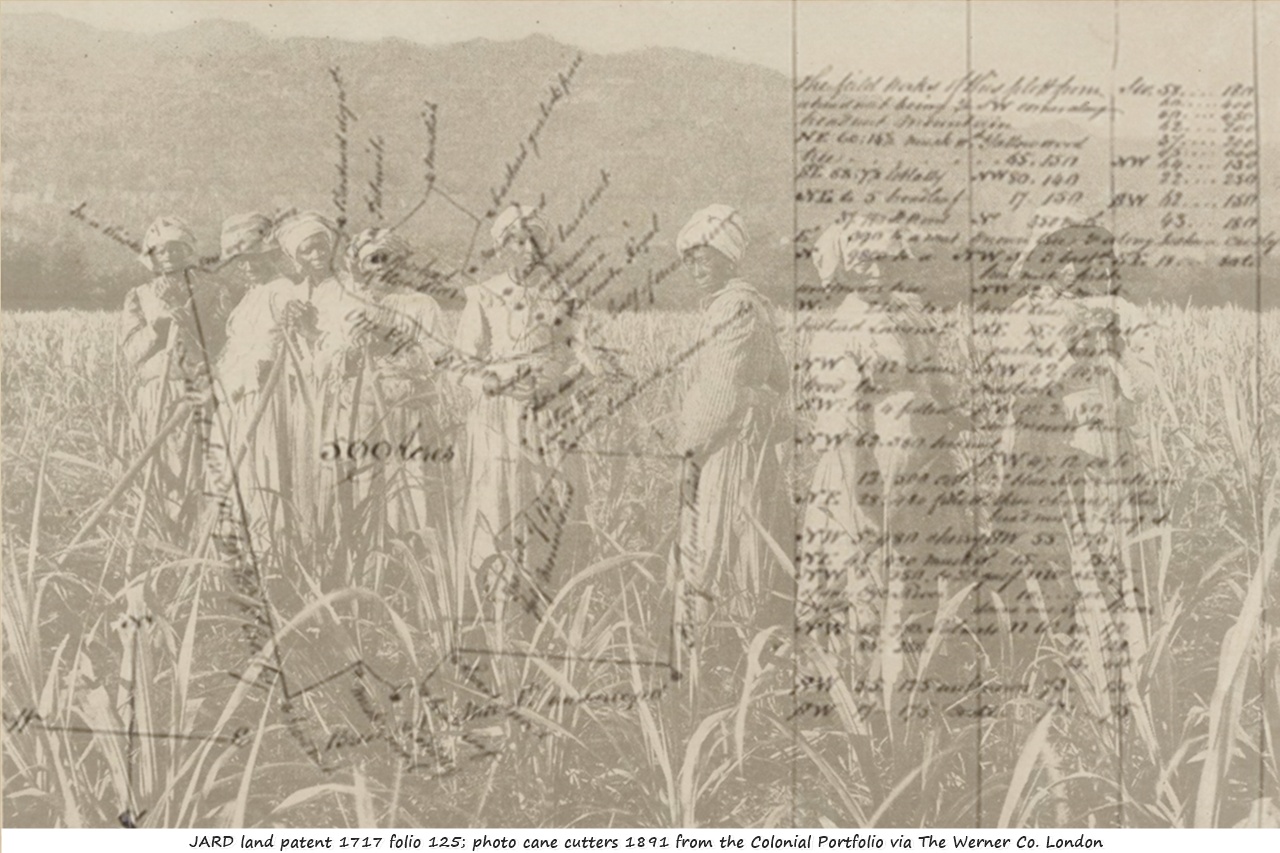
Historical documents retrieved through painstaking research in the UK and Jamaica by founder Dr Deborah Gabriel, have been uploaded to this website to help tell the story of Jenny Harriott and her descendants.
The Enslaver Harriotts
Historical documents include details of 1805 acres of land obtained for free from the British Government in the 1700s to encourage white settlers to migrate to Jamaica and cultivate sugar plantations using slave labour. The first Harriott to obtain land in Jamaica was John Harriott from England, born in 1680. He received 500 acres of land in 1707 and 300 acres in 1718, in St Elizabeth. He received further land, along with sons William and George totalling 1005 acres between 1729 and 1787. This land and plantations passed down the generations through his son George (1710-1758), grandson George David Snr (1746-1805), great grandson George David (1781-?) and great, great grandson John Harriott (1803-?), the enslaver of Jenny Harriott and her son, Francis. John Harriott received 96 pounds, 6 shillings and 4 pence for six slaves in 1835, including Jenny and son Francis. In 2026, this equates to around £16,000. However, across Jamaica the Harriotts received £1.2 million in todays value for 494 enslaved people. It should also be noted that in over 100 years, at a modest estimate Harriott slave owners across Jamaica netted around £7.7 million, which in 2026 equates to roughly £1.2 billion.
Love, Endurance, Resistance and Survival
Close examination of the documents reveal the horrors of enslavement and the expendability of the enslaved. For example, Mary Biggs, listed as a Sambo in 1817 (3/4 African and 1/4 European) was aged 17. By 1826 she had 2 children, Caroline aged 4 and Grace aged 1. in 1829 her son John was listed aged 4. Mary, her baby son John and daughters Caroline and Grace were all sold for taxes in 1829. Another tale is that of Eliza (not the wife of Francis Harriott). Eliza was first listed on the Return of Slaves for John Harriott (1803-?) in 1817 aged 12. She was Creole and therefore born in Jamaica. In 1826 she had a son Charles aged 9 1/2 months that year. Sadly, he died in 1832, the same year that Francis Harriott, son of Jenny was born.

The Story of Jenny Harriott
Jenny Harriott was born in 1810 in St Elizabeth. Sadly, slave records were not kept until 1817, so there is no way of knowing who her mother was. She first appears in the Return of Slaves for John Harriott (1803-?) in 1817, aged 7. She was one of 6 enslaved people registered to John Harriott (1803-?), who was aged 14 at the time, and therefore guardian Amelia Brooks signed the register. Analysis of the spreadsheet on the Return of Slaves for John Harriott (1803-?) suggests that he did not run a plantation as there were too few enslaved listed. It is more likely that the enslaved people registered to him in 1817 were acquired from his father, George David Harriott (1781-?). In 1820 he inherited slaves from his mother Mary, who likely inherited them from her husband. John Harriott (1803-?) also received enslaved people as gifts from other slave owners as noted in the spreadsheet. Some of these enslaved people transferred were African, meaning that they were born in Africa, not in Jamaica, as those listed as Creole were. Most of the African enslaved were much older than the Jamaican-born, such as Sarah Harriott, aged 70 and Catherine Young aged 60 in 1826.
Jenny Harriott had two daughters: Caroline aged 4 and Ollif aged 2 in 1832. Both were set free that year. While undertaking research at the Jamaica Archives and Records Department in January 2025, extensive enquiries and assistance from staff suggest that Jenny’s two daughters were freed to offset taxes owed – the fate of Mary Biggs and her daughters. It is likely that because emancipation was just two years away in 1832, and Jenny had baby son Francis, they were kept together. Those aged 5 and over would have had to serve an apprenticeship upon Abolition in 1834, but Francis Harriott escaped this obligation. Emancipated people in St Elizabeth found lodgings and work as planters and labourers, thanks to the Baptists, who acquired many acres of land, some from bankrupt former slave owners, and built churches and schools, providing work farming the land, rearing cattle and growing produce for sale at market. It is surmised that Jenny Harriott and son Francis were among the emancipated forging new lives this way in St Elizabeth.
The Story of Francis and Eliza Harriott
What exactly became of Jenny Harriott after emancipation is not known. Extensive searches at the Jamaica Archives and Records Department for birth and baptism records and searches undertaken at the Registrar General Department for a death record yielded no results. However, what is known for certain is that her son Francis survived, lived in St Elizabeth and worked as a labourer. He met his sweetheart Eliza Young, also born in 1832 in St Elizabeth, and they married in 1850 aged 18. Their first child Thomas Alexander was born in 1850, and younger son Francis Benjamin Harriott (great, great grandfather to Dr Deborah Gabriel) was born in 1852. Eliza Harriott passed away in 1886 and husband Francis 18 years later in 1904. Baptism Records of Their Sons.

Commenting on her research, Dr Gabriel said:
“Historical documents are impersonal and much more information exists on the enslavers than the enslaved. I have tried to tell the story of my ancestors using the limited information available to honour their lives and build a lifelong legacy for all Harriott survivors of enslavement. But for their love, endurance, resistance and survival I would not be alive today to tell their story. I hope I have done them justice, as the whole process has been cathartic for me and a form of self-reparation.”
Sources
Former British Colonial Dependencies, Slave Registers, 1813-1834, Accessed from https://www.ancestry.co.uk/search/collections/1129/
Jemmott, Jenny (2020) The History of the Parish of St Elizabeth. Accessed from https://www.parishhistoriesofjamaica.org/wp-content/uploads/2020/01/The-Parish-History-of-St.-Elizabeth.pdf
Legacies of British Slavery – UCL Department of History 2026 Accessed from https://www.ucl.ac.uk/lbs/
National Library of Jamaica, The History of St Elizabeth. Accessed from https://www.nlj.gov.jm/history-notes/History%20of%20St.%20Elizabeth.pdf